

The daily Connections puzzle looks simple at first.
- What Are the Hints for Connections Mashable?
- Start With the Easiest Connection
- The Yellow Group: Look for the Obvious Link
- The Green Group: Think Beyond the Surface
- The Blue Group: Watch for Specific Categories
- The Purple Group: Expect Wordplay
- A Better Way to Use Connections Hints
- Why Four Words Can Be So Misleading
- Common Mistakes to Avoid
- A Simple Strategy for Difficult Puzzles
- Why Mashable-Style Puzzle Guides Are Useful
- Should You Look Up the Answers?
- Final Thoughts on Hints for Connections Mashable
- Frequently Asked Questions
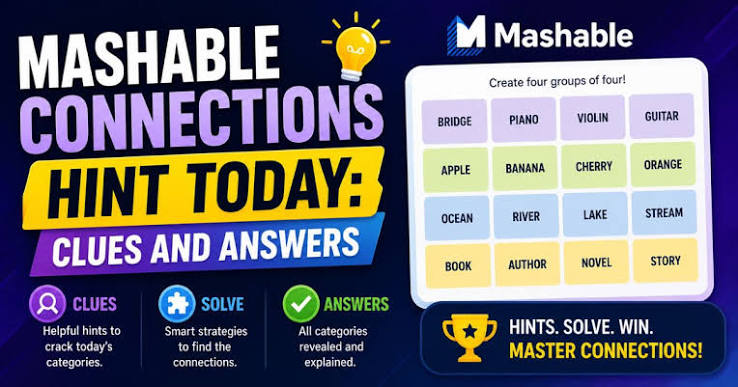
You get 16 words. Your job is to split them into four groups. Each group contains four connected words.
Sounds easy, right?
That is where the puzzle becomes tricky.
Some words can fit several categories. Others are designed to distract you. A single wrong guess can quickly make the board harder.
That is why many players search for hints for Connections Mashable before submitting their final groups. Good hints can point you toward the right idea without ruining the entire puzzle.
What Are the Hints for Connections Mashable?
Mashable has become a popular destination for daily puzzle coverage. Its Connections guides can help players who feel stuck on a difficult grid.
The goal of a hint is simple.
It should give you direction.
It should not immediately remove the challenge.
Connections rewards players who notice unusual relationships. A word might describe an object, an action, a name, or something more abstract.
That creates plenty of misleading combinations.
A useful hint helps you reconsider the board. It does not simply hand you the solution.
Start With the Easiest Connection
The smartest approach starts with obvious relationships.
Look across all 16 words. Do not focus on one word alone.
Ask yourself what four words clearly share.
They might be:
- Common objects used together
- Related actions with similar meanings
- Names belonging to one category
- Words followed by the same term
Finding one strong group reduces the board from 16 words to 12.
That makes everything else easier.
Avoid guessing a group just because four words appear related. Connections often uses overlapping meanings as traps.
The Yellow Group: Look for the Obvious Link
The yellow category is usually the most approachable.
Start here when you need a quick breakthrough.
Look for everyday relationships. Think about common phrases, familiar objects, basic actions, and simple definitions.
The connection may feel almost too obvious.
That can be a good sign.
Still, test all four words before submitting them. One word may belong somewhere else.
The Green Group: Think Beyond the Surface
Once the obvious group disappears, the puzzle becomes more interesting.
The green category often requires another layer of thinking.
A word may have a secondary meaning. It could work as a verb and a noun. It might also form a familiar phrase with another word.
Try changing how you read the board.
Instead of asking, “What does this word mean?”
Ask:
“What can this word be used with?”
That small change can reveal unexpected connections.
The Blue Group: Watch for Specific Categories
Blue groups can feel more specialized.
They may involve entertainment, technology, sports, geography, names, or another recognizable subject.
Look for four words that belong to the same broader field.
Do not worry if the relationship is less obvious.
Connections sometimes expects you to recognize a specific reference.
If three words seem connected, search the remaining words carefully. The fourth word may be less familiar.
The Purple Group: Expect Wordplay
Purple is often where players lose time.
The category can depend on wordplay, unusual meanings, spelling, or phrases.
A word might have several interpretations.
That is exactly what makes the final group difficult.
When you reach this stage, eliminate possibilities instead of guessing.
Ask:
- Can these words share one phrase?
- Can the same word follow each one?
- Can the same word come before each one?
- Do they share a spelling pattern?
- Do they represent different examples of one idea?
Purple categories often become clearer after the other groups disappear.
A Better Way to Use Connections Hints
Hints work best when you use them gradually.
Do not search for the full answer immediately.
Try this order instead.
First clue: Identify the general theme.
Second clue: Look for the type of relationship.
Third clue: Remove obvious wrong choices.
Final clue: Reveal the category only if necessary.
This method keeps the puzzle enjoyable.
It also improves your solving skills over time.
Why Four Words Can Be So Misleading
The biggest challenge is not finding connections.
It is finding the correct connection.
Imagine four words that all relate to travel.
They may seem like a perfect group.
But perhaps only three belong together. The fourth could belong to a category involving something completely different.
This is called an overlap trap.
Connections frequently uses these traps to test careful thinking.
That means you should always ask whether another group works better.
Common Mistakes to Avoid
- Choosing too quickly: Four related words can still be wrong.
- Ignoring meanings: Look beyond the most common definition.
- Forcing groups: Do not make a connection fit.
- Missing phrases: Words may work together naturally.
- Overthinking everything: Simple groups still appear regularly.
- Ignoring leftovers: Remaining words often reveal the answer.
A Simple Strategy for Difficult Puzzles
Use a three-stage process.
Stage One: Scan
Read every word once.
Look for obvious categories. Notice repeated ideas and unusual words.
Stage Two: Test
Build possible groups mentally.
Then challenge each group.
Could another word replace one of them?
If yes, keep searching.
Stage Three: Eliminate
Once one category becomes certain, lock it in.
The remaining 12 words become easier to analyze.
Repeat the process.
This approach prevents random guesses.
Why Mashable-Style Puzzle Guides Are Useful
A good puzzle guide gives players control.
Some people want a tiny clue. Others need a stronger push.
A progressive format works for both.
You can stop after the first hint if you have solved the category. If you remain stuck, move to the next clue.
That makes the experience more satisfying than immediately reading all four answers.
It also keeps the focus on solving.
Should You Look Up the Answers?
There is no wrong way to enjoy a puzzle.
Some players want the challenge without outside help. Others enjoy using hints after several failed attempts.
Hints can provide a middle ground.
You still do the thinking.
You simply get a little direction when the grid becomes frustrating.
For regular players, this can also reveal useful patterns. You begin noticing how categories are constructed.
Over time, that experience can make future puzzles easier.
Final Thoughts on Hints for Connections Mashable
The best hints for Connections Mashable should help without destroying the challenge.
Start with the easiest group. Test every word. Watch for overlapping meanings. Save the hardest category for last.
Most importantly, do not rush.
Connections rewards patience more than random guessing.
When a group finally clicks, the satisfaction comes from seeing the pattern yourself.
That is what makes the daily puzzle worth returning to.
Frequently Asked Questions
What are Connections hints?
Connections hints provide clues about the puzzle’s four hidden categories. They help players solve difficult grids without immediately revealing every answer.
Why is Connections sometimes difficult?
The puzzle often includes words with multiple possible relationships. These overlapping meanings create misleading groups.
What should I solve first?
Start with the most obvious category. Removing four certain words makes the remaining puzzle easier.
Should I use hints before answers?
Yes, if you want help while keeping some of the challenge. Progressive hints are usually better than immediately checking the complete solution.
How can I get better at Connections?
Practice identifying phrases, categories, secondary meanings, and word relationships. Also learn to recognize misleading groups before submitting them.
Disclaimer: This article is intended for general educational and informational purposes. Puzzle details can change with each daily edition, so readers should verify current clues and answers against the relevant puzzle publication.
Read more:Nivea Men vs Bulldog vs Lumin: Which One Fits Gen Z Men?